
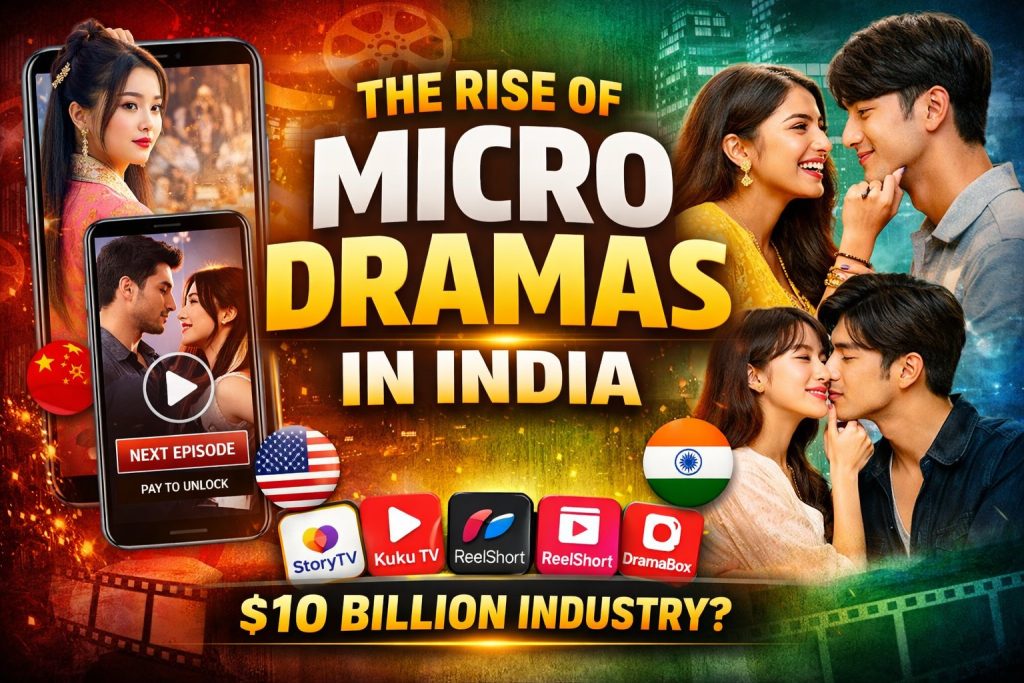
Micro drama series have rapidly evolved into one of the most disruptive forces in global entertainment. What started as a niche experiment in China has now become a full-fledged industry spanning continents, with the United States refining its monetization and India emerging as the next major growth frontier. This transformation reflects a deeper shift in how audiences consume content in a mobile-first, attention-driven world.
Micro dramas are built for smartphones. Episodes typically last between 30 seconds and 3 minutes, yet entire story arcs can extend across dozens or even hundreds of episodes. The format thrives on emotional intensity, rapid pacing, and constant cliffhangers. Unlike traditional OTT content, which demands time and commitment, micro dramas are engineered for instant engagement and binge consumption. In many ways, they function more like mobile games, where retention and progression drive user behavior.
China is where this revolution began, and it remains the largest and most mature market. Today, the country boasts 500–800 million micro drama viewers, making it one of the most widely consumed digital entertainment formats. The industry has scaled to an astonishing $7–9 billion annual market size, with revenues in some periods even surpassing traditional box office collections. The success of micro dramas in China is rooted in a powerful combination of mobile-first consumption, high-frequency usage, and a freemium model where users pay to unlock episodes. This has effectively turned storytelling into a habit loop.
The United States entered the market later but significantly advanced the business model. Platforms like ReelShort and DramaBox have transformed micro dramas into a structured monetization engine. The US market alone has already crossed $1.3 billion in size, and remarkably, it contributes nearly 49% of global micro drama revenue. Globally, short drama apps generated over $2.3 billion in revenue in 2025, reflecting the rapid adoption of this format. The US has also elevated production quality, with better scripts, actors, and storytelling, positioning micro dramas as a testing ground for future intellectual properties.
India is now stepping into what can be described as the “explosion phase.” The country already has an estimated 50 million micro drama viewers, and this number is expected to grow to 150–200 million users within the next 1–2 years. The current revenue run rate in India is around $500 million, with projections suggesting it could soon reach ₹1,200–1,800 crore in the near term. Over the long term, the opportunity is massive, with estimates pointing toward a $10 billion market by 2030.
The platform ecosystem in India is rapidly evolving. Global players such as ReelShort, DramaBox, and ShortMax are aggressively expanding into the market, bringing with them proven monetization strategies. At the same time, Indian platforms like Kuku TV and ShareChat’s QuickTV are focusing on localized storytelling. Emerging platforms like StoryTV are also entering the space, aiming to build culturally relevant, mobile-first storytelling experiences tailored to Indian audiences. The real differentiation in India will come from regional content, unlocking audiences beyond metro cities.
South Korea, while not the largest market, has played a significant role in shaping the creative direction of micro dramas. Korean web dramas introduced compact, emotionally rich storytelling, particularly in romance and youth-driven narratives. Their influence can be seen globally, as creators adopt similar storytelling techniques to enhance engagement. In the broader ecosystem, Korea acts as a creative benchmark, while China leads in scale and the US in monetization.
The rapid growth of micro dramas is driven by three fundamental shifts. First, attention spans have shortened, making quick, engaging content more appealing. Second, smartphones have become the dominant screen, making vertical video the most natural format. Third, monetization models now resemble gaming, where users pay incrementally to continue their experience. This convergence of content and gaming mechanics is what makes micro dramas uniquely powerful.
Looking ahead, India’s micro drama industry is poised for exponential growth. Regional language content will likely drive the next wave, supported by influencers and creators transitioning into storytelling roles. Artificial intelligence will further accelerate production, enabling faster and more cost-effective content creation. There is also a strong possibility of convergence with gaming, where interactive storytelling allows users to influence narrative outcomes.
Globally, the micro drama industry has already crossed $11 billion in value, with China leading the market, the US driving monetization innovation, and India emerging as the fastest-growing region. In India alone, the trajectory from $500 million today to a potential $10 billion market signals a massive opportunity.
What makes micro dramas particularly compelling is that they are not competing with traditional OTT platforms like Netflix. Instead, they are competing for the same attention pool as Instagram Reels, YouTube Shorts, and mobile games. By combining the addictive nature of short-form video with the depth of serialized storytelling, micro dramas have created an entirely new category.
For India, this is more than just a trend. It represents a fundamental shift in storytelling, distribution, and monetization. Much like television soaps once defined an era and OTT platforms reshaped viewing habits, micro dramas could very well become the next dominant force in the country’s entertainment landscape.