
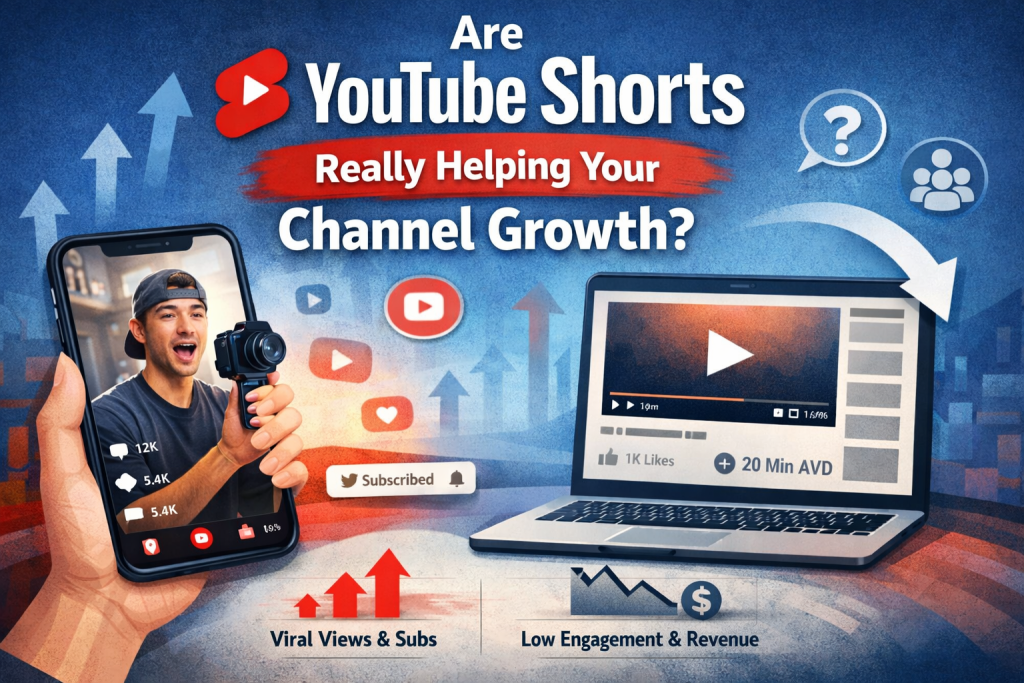
The rise of YouTube Shorts has sparked an important question among creators and brands alike: are Shorts truly driving sustainable channel growth, or simply inflating vanity metrics like views and subscribers?
At a glance, Shorts appear to be a powerful growth engine. However, a deeper analysis reveals a more nuanced reality – one that every serious content creator and business should understand.
The Illusion of Growth
On the surface, Shorts deliver impressive results. Many creators experience rapid spikes in views and subscriber counts within a short period.
In fact, it’s not uncommon for channels to cross 1,000 subscribers within weeks through consistent Shorts publishing – something that typically takes months with long-form content.
But this growth often comes with a critical limitation: audience quality.
Shorts viewers are generally passive consumers. They scroll quickly, engage minimally, and rarely transition into loyal viewers of long-form content. As a result, while numbers grow, meaningful engagement often does not.
Two Distinct Audiences
One of the most consistent insights from creators is that Shorts and long-form content attract fundamentally different audience behaviours.
Think of it as operating two parallel audiences under one brand:
- Short audience: Quick consumption, low attention span, swipe-driven behaviour
- Long-form audience: Intentional viewing, higher retention, deeper engagement
Even when creators strategically link long-form videos within Shorts, conversion rates remain significantly low. Most users continue scrolling rather than clicking through.
This leads to a disconnect – your subscriber count increases, but your core content performance remains stagnant.
The Subscriber Trap
A growing subscriber count may look like progress, but it doesn’t always translate into real channel growth.
Why?
Because a large portion of Shorts-driven subscribers:
- Do not watch long-form videos
- Do not contribute to watch time (a key factor for monetization)
- Do not engage consistently with your content
This creates a paradox: a channel that appears successful on paper but struggles to generate revenue, retention, or community.
When Shorts Actually Work
Despite these challenges, Shorts can be highly effective – when used strategically.
They deliver the best results when:
- Content is closely aligned with your core niche
- Shorts act as entry points or teasers, not random standalone clips
- There is consistent storytelling, branding, or thematic continuity
In such cases, even a single Short can drive significant subscriber growth. The key differentiator is audience alignment.
If your Shorts attract the wrong audience, they can dilute your channel’s long-term performance.
The Long-Form Advantage
Creators who prioritize long-form content often experience slower – but far more sustainable – growth.
Key advantages include:
- Higher average view duration (AVD)
- Stronger monetization potential
- Deeper audience loyalty and retention
Many experienced creators report that focusing on long-form content builds compounding growth over time, aligning better with YouTube’s recommendation system and revenue model.
The Real Strategy: Balance with Intent
The real question isn’t whether Shorts are good or bad – it’s how you use them.
From a digital marketing perspective, Shorts should be treated as a top-of-funnel discovery tool, not the core growth strategy.
Used correctly, they can:
- Increase visibility
- Expand reach to new audiences
- Validate content ideas quickly
However, they should always support – not replace – your long-form content strategy.
Final Takeaway
YouTube Shorts are a double-edged sword.
They can accelerate growth metrics, but metrics alone do not build a brand or a business.
If your goal is long-term growth, revenue, and audience loyalty, your primary focus must remain on delivering high-value, engaging long-form content.
Shorts should amplify your strategy – not distract from it.
Because ultimately, the metric that matters isn’t views or subscribers – it’s whether your audience stays, watches, and comes back.