
India’s advertising industry is at a fascinating crossroads. On one side sits the massive, decades-old ecosystem of television and print. On the other, a fast-evolving digital universe powered by platforms, performance marketing, and increasingly, influencers. To understand how this shift is unfolding, it helps to look at the numbers first and then interpret what they actually mean.
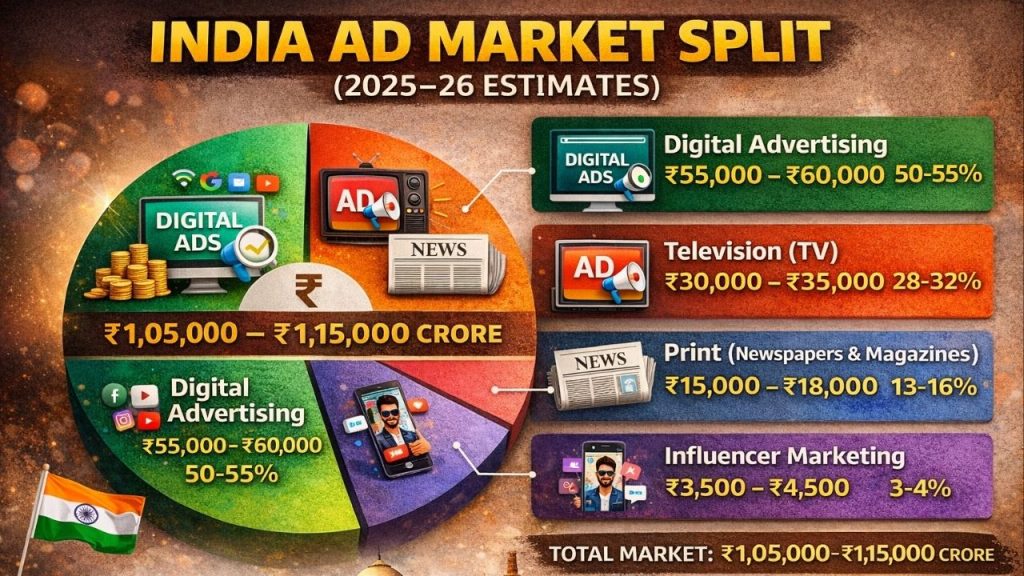
As of 2025–26, India’s total advertising market stands at roughly ₹1.05–1.15 lakh crore. Within this, digital advertising has emerged as the largest segment, accounting for approximately ₹55,000 to ₹60,000 crore, or about 50–55% of the total spend. This dominance is driven by platforms such as Google, Meta, and Amazon, which offer precise targeting and measurable performance. Businesses today are no longer satisfied with visibility alone; they want conversions, and digital delivers that with unmatched efficiency.
Television, however, continues to hold a powerful position, contributing around ₹30,000 to ₹35,000 crore, or roughly 30% of the market. Its strength lies in scale. Events like the Indian Premier League still command massive national attention, making TV the preferred medium for brands like Hindustan Unilever and Procter & Gamble when they want to reach millions in a short span of time. Television excels at building awareness, particularly in rural and mass markets, but it lacks the targeting precision that digital platforms offer.
Print media, while declining globally, continues to maintain a meaningful presence in India, contributing about ₹15,000 to ₹18,000 crore, or 13–16% of the market. Publications under groups like Times Group and Jagran Prakashan still command trust, especially in Tier 2 and Tier 3 cities. For sectors like real estate, education, and government advertising, print remains an important channel because of its perceived credibility and local reach.
Then comes influencer marketing, the smallest yet most disruptive segment. Currently valued at around ₹3,500 to ₹4,500 crore, it represents just 3–4% of total ad spend. On paper, this seems insignificant. But that would be a misleading conclusion. Influencer marketing is growing at 25–30% annually, far outpacing every other segment in the industry. Platforms like Instagram and YouTube have enabled creators across India to build highly engaged audiences, often in regional languages, making their influence deeper and more personal than traditional ads.
What makes this shift particularly interesting is not just the difference in size, but the difference in function. Television still builds fame. Digital advertising captures intent. Print reinforces trust in specific contexts. Influencers, however, operate at a different level altogether. They shape perception and drive decisions. In many cases today, a consumer may discover a brand through a TV ad, research it through Google, but ultimately make the purchase because a creator they trust recommended it.
This is why modern advertising in India is no longer about choosing one channel over another. Instead, it is about integration. A typical campaign might begin with a high-impact TV push during the IPL, followed by targeted digital ads, and then amplified through influencer collaborations that bring relatability and credibility. Interestingly, despite the smallest budget allocation, influencer campaigns often generate the highest engagement and, in many cases, the strongest conversion rates.
The deeper shift here is psychological. Traditional advertising speaks to consumers, while influencers speak with them. In a country as diverse and culturally layered as India, this distinction matters enormously. A regional creator communicating in Odia, Hindi, or Tamil can often influence buying behavior more effectively than a polished national campaign.
So while the numbers still favor traditional and digital advertising in terms of scale, the balance of power is slowly shifting. Influencer marketing may be just 4% of the market today, but its impact extends far beyond that share. It is not replacing television or print, but it is redefining how effective advertising works in India.
The future, therefore, is not a battle between channels. It is a collaboration. Television will continue to build reach, digital will optimize performance, print will sustain credibility, and influencers will bring trust into the equation. And increasingly, it is that trust that will determine which brands win.