
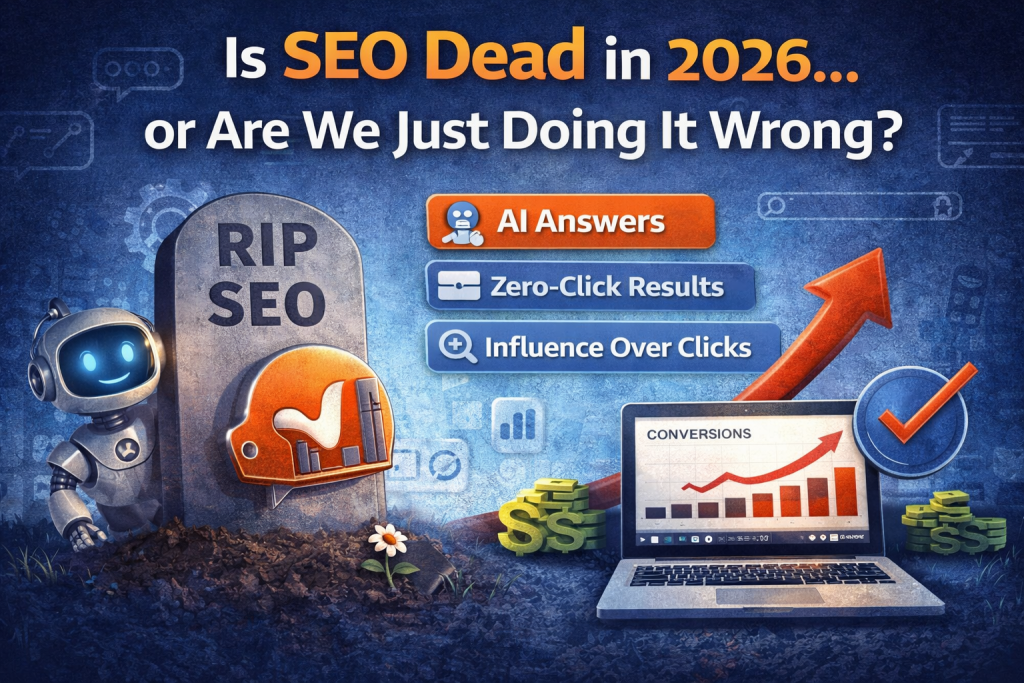
If your website analytics have been triggering quiet concern lately, you’re not alone.
Search behaviour is evolving faster than at any point in the past two decades. AI-generated answers, zero-click results, and conversational interfaces are fundamentally changing how users discover information.
Naturally, this raises a critical question: Is SEO still worth it in 2026?
The short answer: SEO is not dead. But outdated SEO is.
The Illusion of Decline
At first glance, it does feel like SEO is losing relevance.
Users are increasingly getting answers directly on search results pages. AI tools summarize content instantly. Many queries never result in a click.
As one marketer observed:
“Half my searches don’t even lead to a website anymore.”
That observation is valid – but incomplete.
Search isn’t shrinking. It’s expanding.
What’s changing is where and how value is captured.
SEO Has Shifted from Clicks to Influence
Traditionally, SEO success was measured by:
- Rankings
- Impressions
- Click-through rates
In 2026, that model is being redefined.
Today, success looks like:
- Being cited by AI systems
- Appearing consistently across the buyer journey
- Building brand recall – even without clicks
This marks a fundamental shift.
You are no longer optimizing only for users clicking links – you are optimizing for systems that interpret, summarize, and recommend your content.
In many ways, SEO is evolving into Answer Engine Optimization (AEO).
The Traffic Paradox
One of the most overlooked shifts in modern SEO is what we call the traffic paradox.
Many websites are experiencing:
- Lower overall traffic
- Higher-quality conversions
Why?
Because AI and smarter search systems filter out low-intent users. The people who do click are:
- More informed
- More intentional
- Closer to making a decision
Historically, informational content converted at under 2%. Today, AI-assisted journeys are sending users who are significantly more “decision-ready.”
So while traffic may decline, revenue and ROI can increase.
What Kind of Content Still Wins?
This is where most brands and creators go wrong.
Generic content is dying.
If your strategy still revolves around:
- “What is X?” articles
- “Top 10 benefits of Y” lists
- Rewriting existing content
…then AI will outperform you.
However, content that continues to win includes:
- Original research and proprietary data
- Real-world insights and benchmarks
- Tools, calculators, or interactive elements
- Strong opinions and first-hand experience
The rule is simple:
If AI can easily replicate your content, it will replace it.
Google Is Still Dominant (For Now)
Despite the rapid rise of AI tools, traditional search engines still dominate at scale.
- Billions of searches still happen daily
- AI-driven traffic remains a small percentage for most websites
- Many marketers report AI contributing only a fraction of total traffic
Abandoning SEO today would be a strategic mistake.
But ignoring AI’s influence? An even bigger one.
The New SEO Playbook (2026 Edition)
To stay competitive, your SEO strategy must evolve across multiple dimensions:
1. Optimize for Citations, Not Just Rankings
Ask: “Will an AI system reference this?”
Use structured content, clear insights, and credible data.
2. Build Authority, Not Volume
10 high-quality pieces will outperform 100 low-value articles.
Depth has replaced keyword density.
3. Be Present Across Platforms
Search is no longer limited to search engines. It includes:
- Communities and forums
- Social media platforms
- Video ecosystems
- User-generated discussions
Your brand needs to exist wherever conversations happen.
4. Focus on Brand Recall
Even without immediate clicks, repeated exposure builds trust.
Over time, users will search for your brand directly.
So… Is SEO Dead?
No.
But lazy SEO is dead.
The era of:
- Keyword stuffing
- Thin, low-value content
- Mass-produced blog posts
…is over.
What remains is far more demanding – and far more rewarding.
Final Takeaway
SEO in 2026 is no longer about gaming algorithms.
It’s about earning relevance in a system where machines decide what humans see first.
If your content deserves to be cited, it will succeed.
If it doesn’t, no amount of optimization will save it.
And that’s not the death of SEO.
It’s its long-overdue evolution.