
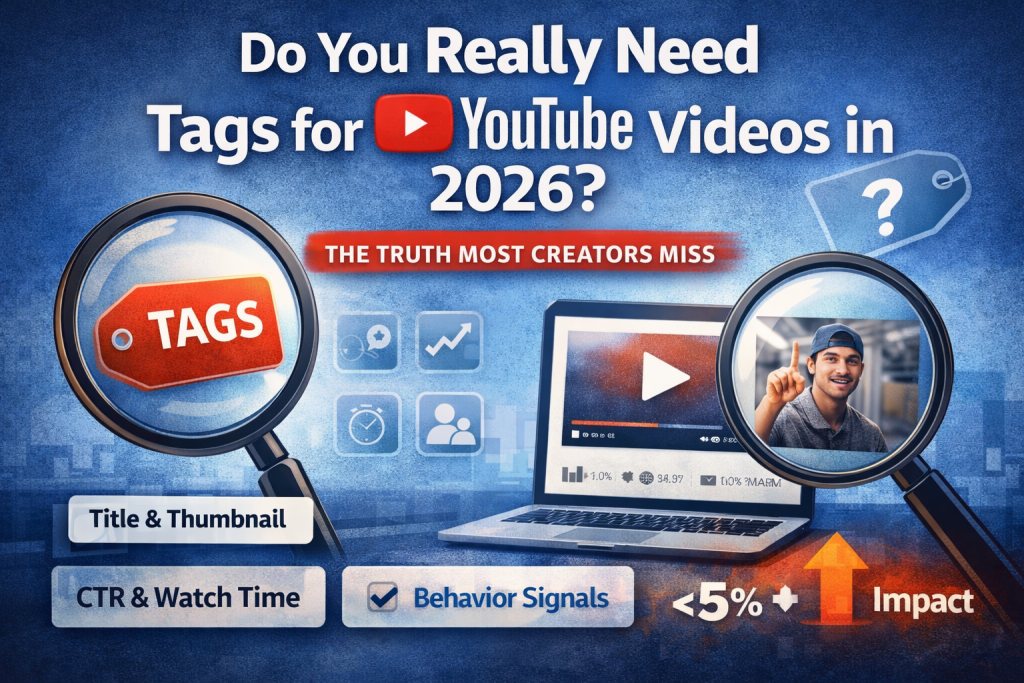
In the ever-evolving ecosystem of YouTube, creators are constantly searching for that one hidden lever to boost visibility, increase views, and crack the algorithm.
For years, video tags were considered a core part of YouTube SEO. But in 2026, the landscape has shifted significantly.
So the real question is: Do tags still matter – or are they just a legacy feature creators overestimate?
Let’s break it down with both platform-level insights and real creator experiences.
The Reality: Tags Are No Longer a Primary Ranking Factor
YouTube’s algorithm has evolved from keyword-based discovery to behavior-driven recommendations.
Earlier, tags helped categorize videos. Today, YouTube relies far more on:
- Title relevance and clarity
- Thumbnail click-through rate (CTR)
- Watch time and audience retention
- Description context and keyword usage
- Viewer behavior and session signals
According to platform insights and multiple creator experiments, tags now play a minimal role in discovery.
Their primary function? Supporting edge cases like misspellings or contextual reinforcement – not driving reach.
What Real Creators Are Saying
Insights from creator communities (including platforms like Reddit) strongly reflect this shift.
Common consensus:
- Tags have very low impact today
- They don’t harm performance if used
- They may offer a slight edge for new channels
As one creator insight puts it:
“Tags aren’t hugely relevant anymore, but they can still help a tiny bit when you’re starting out.”
This aligns with real-world observations across emerging creators competing in saturated niches.
When Tags Still Matter (Slightly)
While tags are no longer powerful, they’re not entirely useless either. They still provide marginal value in specific scenarios:
1. New Channels Establishing Context
For channels with limited data, tags can act as early signals to help YouTube understand content categorization.
2. Competitor Targeting (Suggested Videos)
Some creators use tags from trending or high-performing videos to increase chances of appearing in the “Suggested” feed.
3. Misspellings & Variations
Tags allow you to include alternate spellings, synonyms, or phrasing that may not fit naturally into titles or descriptions.
The Numbers Perspective
To put things into context:
- Tags contribute <5% impact on video discovery (based on multiple creator studies)
- CTR + Watch Time together contribute 70%+ influence
- Over 500 hours of video are uploaded every minute on YouTube
In such a competitive environment, relying on tags is like trying to win a race with a slight tailwind – while ignoring the engine.
The Smarter Strategy: What Actually Drives Growth in 2026
From a digital marketing standpoint, focusing on high-impact levers is non-negotiable.
1. Title + Thumbnail = Your Growth Engine
Your packaging determines whether your content gets a chance. Even a 2–5% increase in CTR can significantly impact views.
2. The First 5 Seconds Decide Everything
Retention is the real algorithm trigger. If viewers stay, your video gets pushed further.
3. Descriptions That Add Context
Use keywords naturally and strategically. Descriptions provide far more contextual clarity than tags ever did.
4. Niche Consistency Builds Authority
YouTube favors creators who build topical depth and audience trust over time.
So, Should You Use Tags or Not?
The honest, no-nonsense answer:
- Yes – use them, but don’t overthink them
- Treat tags as a minor optimization layer, not a growth driver
- Follow the 90/10 rule:
- 90% effort → Content, storytelling, packaging
- 10% effort → Metadata (tags, descriptions, etc.)
Tags won’t make your video go viral—but skipping them entirely is unnecessary when they take seconds to add.
Final Takeaway
YouTube in 2026 is no longer a keyword-first platform – it’s a behavior-first ecosystem.
The algorithm isn’t asking: “What is this video about?”
It’s asking: “Do people actually care enough to watch this?”
And that changes everything.
If your strategy aligns with audience behavior, engagement, and retention, tags naturally fall into their rightful place:
A small assist – not the main driver of growth.